From Gaza, with Love

Sunday, December 17, 2006

iam sad and not proud

18th of december gaza 10 am sunday -7pm

iam sad , angry , and not proud of what is going on in Gaza streets at the moment , Palestinian Palestinian fight and , Israeli occupation watching us with the famous old policy of occupation , divide and rule ,what a waste of energy and efforts toward acheiving our national goals , towards free and independent Palestine, towards acheivment of peace that is based on justice ,
i couldnot go to my work , i was confined to my home , i live too close to the presedent home and office actualy i could see the presedent guards from my window ,it was not safe for me to have a quick look the shooting between the fatah and hamas, the two fighting parties was too feirce ,
iam hoping that this unnecessary fight will end soon and will not lead to a civil war
the only exit out of this dielema is a national unity goverment , with the participation and input of the different parties , a goverment that have the power, the determination and wisdom to lift the sanctions , and force the world to support the Palestinian anlianable national rights ,

Monday, December 11, 2006

Apeal from Gaza

From Gaza, where we write as different health NGOs and individuals working
in the health field, we send our deep feelings of appreciation for your
gathering . We see it as a genuine attempt to say “stop – enough of
ongoing health violations of human rights by Israel”. These have greatly
> intensified during the last 4 months of the ongoing Israeli military
> operation against Gaza.
>
> During the latest assault against the village of Beit Hanoun in the north
> of Gaza, civilians were greatly affected by the brutal practices of the
> Israeli army during six continuous days. Women in labour gave birth on the
> road while waiting for permission to go to hospital. Some of the injured
> bled to death while waiting for the same permission. Four emergency health
> rescue officers were killed while on duty and wearing clearly visible
> uniform. Within the last 4 months, the movement of ambulances was greatly
> hindered by the army.
>
> We, the Palestinian health providers in the non governmental sector
> express our deep concern at the rapid deterioration of health conditions.
>
> A whole nation of 1.4 million is living under disastrous humanitarian
> conditions. We have endured without electricity for a continuous 4 month
> period, we watch daily as increasing numbers of cancer patients die while
> waiting to cross the borders for futher treatment in Egyptian hospitals –
> they were denied the right of treatment because of the imposed border
> closure between Gaza and Egypt. Economic sanctions imposed by Western
> governments have left 70% of Gazans living below the poverty level . As a
> consequence 42% of Gaza children under 5 years of age suffer from iron
> deficiency anaemia. Post traumatic stress disorder has reached 60% amongst
> children in the north of Gaza , where the atrocities reached their
> maximum.
>
> Medics are working under fire. Many hospitals were either randomly
> attacked or besieged, preventing the injured from reaching them as
> happened recently in Beit Hanoun.
>
> It is time now for all of us who believe in justice and peace, believe in
> humanity as one family, and in solidarity between health workers
> worldwide, to take a further step and stronger stand – a non violent act
> of sanctions against Israeli health institutions, those various
> universities and hospitals that support the inhuman acts against
> Palestinian people through the Israeli occupation. At the same time we
> need to strengthen our relations and bonds with those courageous Israeli
> health institutions and organizations who refuse the brutal acts of the
> Israeli occupation and work hard for peace and stability in the region,
> based on recognition of the Palestinian people’s inalienable rights.
>
> From our big prison where we are incarcerated in our own country, where we
> do not feel that any place is safe or anybody is immune, where we cannot
> even protect our children or our patients, we thank you for your
> solidarity. We hope for a better future for generations to come when this
> conflict ends and this Israeli occupation passes into history, along with
> the South African apartheid regime.
>
>
> [signatures to follow]

Palestinian Non govermental organisations networking(PNGO)
health sector organisations of PNGO
union of health work committees
Palestinian red crescent society
Gaza community mental health programme
union of Palestinian health welfare committees
medical releif society
Univeristy Teachers' Association-Palestine
The Idependent Palestinian Association for Tracking Israeli War Criminals
The Arab Forum
The Nasserist Current

Palestinian red crescent society

AlAWDA hospital .emergency room nurses and doctors-jabalia refujee camp
>> . ambulance drivers of AlAwda hospital
community based rehabilitation center
>> union of palestinian women committees
adameer for human rights association
middleast children alliences -Gaza
DR. Mona Elfarra
dr. rmuhanna
dr. yuosef moussa
dr. aed yagi
dr. tayseer sultan
and many more living and working in Gaza

for more information plz contact
dr. Mona ElFarra -Gaza- AlAwda hospital health and development consultant
, human rights nd women aactivist in Gaza
mona@gaza-health.org

Can any body answers Ghassan Abdullah?

Why is Israel separating me from my wife? asks Ghassan Abdullah
Date: 07 / 12 / 2006 Time: 15:58


Originally published on The Electronic Intifada
6 December 2006

Israel has decreed that my wife and I can no longer live together. I am
Palestinian and she is Swiss and we have been married for 28 years. She
was recently given two weeks to leave the occupied Palestinian
territory. The Israeli Ministry of Interior wrote on her Swiss passport:
"LAST PERMIT." We have been living together in Ramallah for 12 years. We
came in 1994, when, after the Oslo Agreement, we were encouraged to move
to the West Bank by the prospect of 'peace' and development.

My wife Anita speaks Arabic, likes the landscape, cooks Arabic meals,
and she cares for my grandfather's village house -- an old stone
building and the plants around it -- more than I do. She votes in
Palestinian elections as the spouse of a Palestinian. She is active in
serving the local society in public health. She has numerous friends
here and considers it home. She still has her valuable European element
and contacts, but she doesn't want to be separated from this environment
or from me, and I certainly do not want to be separated from her. Our
children are grown up and work abroad, but they are also not sure they
will be allowed to visit us here. On her way to visit us in Ramallah a
few months ago, our daughter, who has a Swiss passport, was delayed for
six hours at Tel Aviv airport and grilled when she landed. She was
lucky. Others are deported to where they took off from, often spending a
night or more at the notorious detention 'facility' at the airport.

For the past 12 years, Anita has managed to stay here by diligently
renewing her permit or leaving and coming back every three or six months
to comply with the Israeli 'law' that applies in the occupied
Palestinian territories. She is fighting now to stay here by going to a
lawyer and to the Israeli courts, hoping for an injunction to be able to
stay until a verdict is reached. She is also in touch with her embassy,
and she has joined others in the same predicament in addressing the
European Union and the American consulate, and in talking to human
rights organizations, both Israeli and Palestinian, and the media.

We don't know what to do. But whatever it is, we have to do it quickly.
What do we do about our shared life, our papers and accounts, the
hundreds of little things that we have grown to share? What do we do
about the new apartment that we made the 'mistake' of purchasing at the
wrong time? She was keyed up about what tiles to choose and how to model
the kitchen. We can't believe, or accept, that we are going to be
separated. We believe it though, when we are reminded by other 'mixed'
couples or families around us who have, and are being, separated.

Since last spring, the Israeli occupation authorities have been
increasing the squeeze on holders of foreign passports by denying them
entry into the Palestinian areas. Those affected include Palestinians
with foreign passports or foreign wives, husbands, children, parents and
other relatives. They also include foreign nationals, who come to teach
at universities, work or volunteer with local or foreign
non-governmental organizations, experts with various projects often
funded by European countries, sympathizers or human rights activists.

Bitakhon is the magic word in Israel. In the name of bitakhon, or
security, Israeli authorities can take any illegal, inhuman, immoral or
aggressive measures against the Palestinian population under military
occupation. They can throw the word bitakhon at any European or foreign
diplomat who questions any of their measures, even when those measures
go against human rights, international and humanitarian law, or the
Fourth Geneva Conventions which govern the conduct of occupying powers
towards the occupied population. It seems sometimes, to Palestinians,
that a third rate official at any Israeli ministry can frighten the
whole of the European Union and its officials by invoking the 'security'
of Israelis, or by hinting at what Europe did to the Jews.

My wife is not the only one to have been given an ultimatum this last
week. Dozens of other wives, husbands and children who have been living
in the West Bank for years, renewing their Israeli-issued 'visitors'
permits every three months, have been given short extensions, none of
which exceed the end of this year. Children will have to be taken out of
schools and will be separated from their parents. Mothers, fathers,
sisters, brothers and grandparents of the cherished local extended
families will be torn apart. Hundreds of others are also waiting their
fate in the coming days and weeks. Thousands have been denied visits
this last summer to their families and homes and roots. Summer is often
the season for marriage of Palestinians divided by different passports
or IDs and festivities used to fill the summer nights with music and
dance. Not in the summer of 2006.

The Israeli occupation does not stop at confiscating the land. I feel
occupied in my shirt pocket. My 'Palestinian' identity card is issued by
Israeli authorities. They control the Palestinian civil population
registry. Every birth, death, marriage, travels in or out, is controlled
by Israel -- even in Gaza, disengagement withstanding. Of course, they
control the water, the roads and the movement of people within the West
Bank through hundreds of barriers and checkpoints. They uproot all the
trees that they decide are in their way, that are in the way of the
Apartheid Wall cutting its way into the flesh of our land, or in the way
of their colonial settlers who decide to take over yet another spot of
land or hill top that pleases them.

Why are the Israelis attacking mixed marriages of Palestinians? Before
people fall in love in Palestine now, they ask about what ID each holds
and from where it is issued. They do not want to build a life at risk of
being torn apart from the start.

-----------------
Ghassan Abdullah is a computer adviser in the West Bank city of Ramallah

Friday, November 24, 2006

human rights and beit hanoun residents

--------------------------------------------------------------------------------


Residents of Beit Hanoun turned out to see Arbour as
she toured the town but were not hopeful her visit
would achieve any results.


By Nidal al-Mughrabi

Beit Hanoiun, Gaza (Reuters) - A senior United Nations
official described Gaza as suffering "massive" human
rights violations during a visit to the territory on
Monday and urged all sides to be bold in trying to end
the violence.

"The violation of human rights I think in this
territory is massive," Louise Arbour, the U.N. high
commissioner for human rights, told reporters during a
visit to Beit Hanoun, a town the Israeli army shelled
earlier this month, killing 19 civilians.

"The call for protection has to be answered. We cannot
continue to see civilians, who are not the authors of
their own misfortune, suffer to the extent of what I
see."

Arbour, on a five-day trip to the region, spent time
at the house of a family who had lost more than a
dozen members in a shelling on Nov. 8, when Israel
says a mistake led to the barrage of artillery shells
hitting the neighbourhood.

Her visit, the first she has made to the region since
becoming commissioner, comes days after the U.N.
General Assembly approved a resolution that "deplored"
Israel's shelling of Gaza and called for an immediate
cessation of violence.

Asked what she planned to do about the rights
violations, Arbour said: "I will help to keep the
conscience of the many who care about what happens in
this part of the world alive.

"I will speak to the Palestinian Authority about their
responsibility to enforce the law, to create an
environment in which people can seek protection of the
law and, of course, I will also speak to the Israeli
authority.

"We need to collectively call on leaders, political,
military and militia leaders, to have the courage to
break the cycle of violence to ensure the well-being
of civilians."

More than 350 Palestinians, almost half of them
civilians according to Palestinian doctors and human
rights workers, have been killed since Israel launched
an offensive in Gaza in late June, following the
kidnapping of an Israeli soldier.

The offensive was designed not only to try to trace
the captured soldier, who was seized by militants
including members of the governing Palestinian faction
Hamas, but also to stop militants firing rockets into
Israeli territory from Gaza.

Israeli authorities say militants have fired more than
300 of the homemade rockets into southern Israel this
year, targeting towns like Sderot, just across the
frontier from Gaza.

Last week, a woman resident of Sderot was killed, the
first death from a rocket attack since July 2005.
Others have been wounded and scores are treated each
week for shock.

Residents of Beit Hanoun turned out to see Arbour as
she toured the town, where many buildings are scarred
by shrapnel, but were not hopeful her visit would
achieve any results.

"It will not do anything," said Majdi al-Athamna, 37,
who lost his son and three brothers in the shelling.

"This visit will not achieve anything unless the world
pressures Israel to engage in a real peace process
because as Palestinians we are paying the price of the
false peace."

Wednesday, November 22, 2006

Palestinian NGOS handed letter to the UN High Commissioner For Human Rights

20|11|2006

Her Excellancy
Ms. Louise Arbour,,,,
The UN High Commissioner for Human Rights


With respect and appreciation:


The Union of Palestinian Non-governmental Organizations would like to express its sincere welcome for your visit to the Occupied Palestinian territories which corresponds with more escalations and assaults by the Israeli Occupation Forces against civilian people and objects.

Your visit is extremely essential to us as we were anticipating it for a long period of time and in fact demanded it frequently particularly during times of the continuation of Israeli Forces grave violations of international human rights and all international conventions. Your visit comes in times the Human Rights Council endorsed sending a fact-finding mission to the Occupied Territories to investigate the massacre of Beit Hanoun that was committed by the Israeli Occupation Forces, which was not the first in the bloody history of Israeli Occupation.

We call upon you today to call for international protection for Palestinian people and to pressure the Occupation of Israel to halt its crimes and assaults on Palestinians, and to work diligently to impose sanctions on the Israeli Occupation Forces as well as follow the Israeli war crime perpetrators and bring them before justice.

Additionally, we call upon you to lift the imposed siege and the unfair international sanctions imposed on the Palestinian people, who are suffering tremendously as a result of aggravation in their economical, social, health, and humanitarian conditions as a result of the unprecedented increase in unemployment and poverty.

Moreover, we call upon you to genuinely pressure the Israeli Occupation government to release the confiscated tax revenue money of Palestinians as well as lifting the economical siege imposed by the occupation authorities on the whole OPT.


We would like to indicate that our people in the West Bank are suffering tremendously particularly with the continuation of building the discrimination and apartheid wall and blockade and confiscation of land as well as enlargement of settlements and other grave violations that the Israeli Occupation Forces commit. For this, we need an immediate and genuine intervention to rescue the international law and human rights conventions, particularly the conventions that call for protection of Palestinian civilians.

We also appeal to you to work on releasing all Palestinian prisoners in the Israeli Occupation jails, especially political leaders, Ministers, Legislative Council members, and children & women.

We would like to appeal to you to send special UN Rapourtuers to the Occupied Palestinian Territories in order to witness first hand the Israeli Occupation Forces blatant violations committed against all Palestinian people sectors.

We also call upon you for more actions in terms deployment of International human rights observers in the Occupied Palestinian Territories including Jerusalem, similar to what is happening in many areas of the world such as Darfour in Sudan.

We call upon you to activate the role of the Human Rights High Commissioners Office in the Occupied Palestinian Territories as we view that it is vital to develop its programs and provide it with more experiences and resources that are appropriate to the mission of the High Commissioner Office for the protection of human rights. Such resources are also vital for the duties that we expect from the High Commissioner Office to perform in the OPT.

We hope that your visit to the Occupied Palestinian Territories will be the first of visits that will be inciting hope for many victims of war crimes, committed by the Israeli occupation Forces against our besieged people living in the biggest prison of the world.

We also would like to mention that we look forward for more roles of the OHCHR in our Arab region, particularly in Lebanon and Iraq who are confronting tyrant occupations.

Lastly, we would like to welcome you and we are full of hope and trust that you will do your utmost efforts to support the fair rights of our Palestinian people who are looking for their freedom and independence.

Please accept our sincere appreciation and gratitude


Union of Palestinian Non-Governmental Network

those are the days my freind ....in Gaza

Dear brothers, sisters, friends, comrades, all of you who follow my blog,

Thanks for your interest in us here in Palestine, while the rest of the world is either silent, cowering to avoid the truth, totally brainwashed by the mainstream media that supports American and Israeli policies in the Middle East, or minding their mutual interests with the USA. Please let us all together work to spread the truth about what is happening in the Occupied Palestinian Territories (OPT), and work hard for a world that enjoys a peace based on justice.

I do apologize for not writing regularly as I used to do. I am very busy with relief efforts and fieldwork. Many of the injured were received into Al- Awda Hospital, which puts extra pressure on all health workers, including myself. It is not an easy feeling to expect that you may lose some of your colleagues while on emergency health rescue missions, or to think of the casualties waiting to cross a military checkpoint, while bleeding and in desperate need for surgical intervention. Some people died while waiting for a permit to pass through those checkpoints.

Whenever I am at Al-Awda Hospital for my field support and needs assessment visits, I meet hospital staff that have lost their relatives, or their homes have been demolished, or they have experienced different sorts of traumas. I also meet many patients and their families. The most heartbreaking is to see children that have been seriously injured. But it is also heavy to listen to the ER doctors tell stories about the different sorts of injuries they receive: mutilated bodies, burn victims, etc.

It is not safe to drive my car the short distance from Gaza to Jabalia and Beit Hanoun. While driving I can clearly see the army tanks and hear helicopters and drones in the sky.

On, Monday 20th of November, I met Mrs. Louise Arbour, the UN high commissioner for human rights, during her visit to Israel and the OPT. She held a meeting with representatives of different Palestinian civil society organizations and public figures where I explained the frank violations of health human rights by the Israeli army. We all strongly asked for international protection following the recent Beit Hanoun masacare and I condemned the American veto that makes the international community very weak in their efforts to refuse injustice and human rights violations in Palestine. The Palestinian people are devastated, abandoned and losing faith in the international community.

The Israeli occupying forces have continued their attack against Gaza, especially in the north of Gaza. First there was the siege and military operation in Beit Hanoun, 2nd –8th of November. And then two days later, the brutal attack against a residential area inside the village, where at least 20 people from one family where killed while in their beds in the early hours of the morning.

Last night, 21st of November, there were many helicopters in the sky above Gaza City. I live nearby the beach and I could clearly hear and see the helicopters. I felt very uneasy, knowing that they will soon target somebody, somewhere in Gaza City. Then I heard the sirens of ambulances. They targeted an area east of the city, killing 2 people including a 70-year-old woman.

This morning, 22nd of November, at 11.30 am the Israeli military went back to Beit Hanoun. Four schoolboys were injured at the new entrance into the village. There are snipers on top of the roofs of some buildings only 300 meters to the east of the hospital. Thirteen casualties were brought into the ER with serious injuries from the snipers’ bullets. I am not in the hospital but I was told this by my colleagues inside the hospital.

I can hear the sirens of the ambulances carrying more injured to Al-Shifa hospital inside Gaza City. The situation is deteriorating.

I shall stop now. But before I stop, I want to tell you that in November, 105 people were killed in Gaza including 35 children and 18 women. Another 350 were injured, many with critical injuries that will cause permanent disabilities.

it is 9.30 pm wed.
i can hear heavy artillary shelling , it is coming from the north of the town . my freind mahmoud telephoned from jabalia to tell me , there are Israeli snipers on top of their next door neiboughers roof ,

This time I promise to keep writing.

With love and solidarity,
Mona

Thursday, November 09, 2006

Amnesty International Delegate Visits Scene of Gaza killings

Wednesday November 08, 2006
Amnesty International Delegate Visits Scene of Gaza
Killings


Those killed, most of whom were asleep in their beds
when their homes were struck by shells fired by
Israeli forces, included eight children.


(Press release, 11/08/2006) - The killing this morning
of 18 civilians in the Palestinian town of Beit
Hanoun, victims of Israeli shelling, was an appalling
act, Amnesty International said today. The
organization called for an immediate, independent
investigation and for those responsible to be held
accountable. It said previous Israeli investigations,
such as that carried out into the killings of a
Palestinian family on a beach in the Gaza Strip last
June, had been seriously inadequate and failed to meet
international standards for such investigations, which
must be independent, impartial and thorough.

Those killed, most of whom were asleep in their beds
when their homes were struck by shells fired by
Israeli forces, included eight children. An Amnesty
International delegate who visited the scene of the
killings shortly after the attack was told that 15 of
the victims were killed in the first strike and that
three others were killed by a second shell as they
raced to help the dead and injured.

“This terrible act follows a renewed upsurge in
killings of Palestinians since Israel forces launched
their latest military operation into the Gaza Strip on
2 November,“ said Malcolm Smart, Director of Amnesty
International’s Middle East and North Africa
programme. “Israeli actions during this entire
operation have been marked by nothing less than
reckless disregard for the lives of Palestinian
civilians, over 20 of whom had been killed even before
this morning’s tragedy.”

In all, before today’s deaths, more than 53
Palestinians were killed during the Israeli military
siege of Beit Hanoun in the northern Gaza Strip, and
many more were wounded. Two ambulance workers were
among the civilians killed. Dubbed “Autumn clouds”by
the Israeli army, the operation began on 2 November
and continued until 7 November when Israeli forces
redeployed outside the town. Israeli authorities said
they mounted the operation in an attempt to prevent
Palestinian armed groups firing home-made Qassem
rockets at Israeli towns and villages near to the Gaza
Strip. Most of the dead were killed in Beit Hanoun,
which was kept under siege throughout the six days,
but others were killed as a result of Israeli military
strikes in the surrounding area.

Amnesty International condemns all attacks on unarmed
civilians and is calling on the Israeli authorities to
establish independent investigations into every
incident in which Palestinian civilians were killed or
injured by Israeli forces, and to bring to justice
those responsible for human rights violations.

As Israeli forces began their siege of Beit Hanoun,
one senior officer, Lieutenant Colonel Yarom, said
that troops had been instructed to avoid causing
civilian casualties. Four days into the operation, in
face of a rising toll of deaths and injuries among
Palestinian civilians, Israel’s Prime Minister Ehud
Olmert declared: “Those Palestinians who have been
wounded were mostly armed, but, to our regret, they
are using innocent people as human shields, resulting
in the injury of uninvolved civilians as well”.

The information gathered by Amnesty International
delegates currently in the Gaza Strip contradicts
this, however, and indicates that at least half of
those killed, including at least two women and several
children, were unarmed bystanders not involved in the
confrontations. The pattern is the same for those
injured as a result of Israeli force air strikes and
artillery shelling.

Those killed or injured as a result of Israeli attacks
include:

Ramzi al-Ashrafi, 16, was killed and seven other
children were injured on the morning of 6 November
when an Israeli shell exploded close by the bus on
which they were travelling to school along a busy road
between Beit Lahia and Jabalya, north of Gaza City.
Najwa Khleif, a 20-year-old teacher who was also in
the bus, sustained severe brain injuries. Doctors
treating her in the intensive care unit of Gaza City’s
main hospital told Amnesty International that she was
in critical condition. The bus was hit apparently in a
failed strike by Israeli forces on a vehicle believed
to belong to a Palestinian armed group. However, the
attack was carried out at a busy intersection during
the morning rush hour, when it could be expected that
the streets would be busy with adults and children
making their way to work and school. The shell which
killed Ramzi al-Ashrafi and injured others in the
school bus, fell near a kindergarten although,
fortunately, without causing further deaths or
injuries there.

Ala’ Mansour al-Khdeir, an 11-year-old girl, one of
two children who were wounded by Israeli fire on 4
November when they were returning home from a morning
at school in Beit Lahia. She was struck by a bullet
which entered the left side of her head and travelled
to the left side of her neck, where it remains lodged,
and remains seriously ill. Her mother told Amnesty
International that Ala’was near home in the Sayafa
area of north-west Gaza, an area where there has been
frequent Israeli army shelling in recent days, when
she was wounded. The other child, a boy, was also
seriously injured.

Ibtisam Masoud, 44, was killed and ten other women,
including Tahrir Shahin, a 37-year-old mother of
seven, were injured by Israeli fire during a women’s
demonstration on the morning of 3 November at the
entrance of Beit Hanoun. Tahrir Shahin, whose leg had
to be amputated, told Amnesty International from her
hospital bed in Gaza city that she and other women
were unarmed and standing less than 100 meters from
the Israeli tanks which fired at them: “Ours was a
peaceful demonstration, we were all women, there were
no men, no militants, no weapons. We were just women
standing in front of tanks. We did not think the
Israeli soldiers would shoot us, but they fired
indiscriminately”.

Heba Rajab, 20, a volunteer with the Palestinian
Centre for Democracy and Conflict Resolution, and
Sou’ad Abu Najem, 43, a mother of eight, both
sustained serious gunshot wounds to their legs and
hands in the same incident. They said they had seen
Israeli soldiers taking aim at the women demonstrators
from the tops of their tanks. The women were
demonstrating in response to a call by a Hamas party
member of the Palestinian parliament to help break the
siege by Israeli forces of a mosque in which members
of Palestinian armed groups were reported to be
sheltering, surrounded by Israeli forces. However, the
women were shot before they could approach the mosque.

Ahmad al-Madhoun, 42, and Mustapha Habib, 26, both
volunteer emergency ambulance workers with the
Palestinian Red Crescent Society (PRCS), and a third
man who was assisting them, were killed in an Israeli
air strike on the evening of 3 November as they were
evacuating the body of a man killed in an earlier air
strike. Iyad Yousef Abu al-Ful, the ambulance driver
accompanying them, told Amnesty International: “Ahmad
and Mustapha were about 20 meters from the ambulance
and were about to load the body of a dead man on the
stretcher; I had just got out of the ambulance and was
beginning to move towards them when a missile struck
at the spot where they were. I got back into the
ambulance and called for help. I cannot get out of my
mind the sight of my colleagues killed while they were
doing their duty”. The medical rescue team was in an
open field near Beit Lahia. It was dark but the
ambulance should have been clearly visible from the
emergency light on its roof. The other victim had
directed the ambulance crew to the body of his friend,
who had been killed earlier in unclear circumstances.

Palestinian ambulances have been frequently attacked
and dozens have been hit by Israeli strikes in recent
years. During the siege of Beit Hanoun, emergency
rescue workers faced increased obstacles and delays in
carrying out their duties due to the virtually
continuous curfew imposed by Israeli forces. Israeli
tanks controlled the access to Beit Hanoun hospital
and delayed the passage of ambulances in and out of
the hospital, as well as into and out of the town.

Zahir Mustapha Shabat, 32, was shot and seriously
injured and his cousin, Mazen Shabat, was killed by
Israeli soldiers in the evening of 4 November when
they were returning home after they had both been
released from three days’ detention by the Israeli
army. He told Amnesty International from his hospital
bed, shortly after he was moved from the intensive
care unit: "After three days in detention the soldiers
released us and gave us a paper, which they said we
could show if we got stopped by other soldiers on our
way home, about 1.5 to 2 km from the place where we
were detained. They told us that they had coordinated
with the tanks in the area and that we would have safe
passage home but when we got about 150 meters from my
house soldiers jumped out of the house of one of my
relatives and fired on me and my cousin, Mazen,
Shabat. Mazen was killed and I was seriously injured
in the abdomen and back."

-For interviews, please contact Amnesty
International's researcher Donatella Rovera in Gaza on
+970 599 446 703 or +44 7771 796 091, or Amnesty
International's Middle East and North Africa press
officer Nicole Choueiry on +44 7831 640 170

Wednesday, November 08, 2006

In Beit Hanoun Again

Israeli artillery bombardment of Beit Hanoun kills at
least 20,
injures over 35, many are women and children
Date: 08 / 11 / 2006 Time: 09:28


A Palestinian father despairs after his
whole family was killed in Beit Hanoun
(MaanImages)
Gaza - Ma'an - Israel has renewed its assault on the
Gaza Strip, killing at least 20 Palestinians on
Wednesday morning.

Palestinian medical sources reported that dozens of
Palestinian citizens had been killed or injured in an
Israeli artillery bombardment of Beit Hanoun in the
north of Gaza Strip. A large number of women and
children were also injured in the shelling.

The sources said the preliminary number of the
citizens killed is 18, but rising. In addition, more
than 35 were injured. Many of the dead arrived at the
hospital fragmented in pieces.

The bombing targeted the house of two brothers, Sa'ed
and Sa'di Al-'Athamneh from Al-Kafarneh district in
the town of Beit Hanoun.

Eleven members of the Al-'Athamneh family were killed,
including a one-year old girl. The killed are:

Ne'meh Al-'Athamneh
Mohammed Al-'Athamneh
Mahmoud Al-'Athamneh
Mahdi Al-'Athamneh
Sa'ed Al-'Athamneh
Mohammed Al-'Athamneh
Fatmeh Al-'Athamneh
Nihad Al-'Athamneh
Arafat Al-'Athamneh
Dima Al-'Athamneh (1 year old girl)
Another young girl, Ala' Al-'Athamneh

The medical services are identifying the rest of the
dead but it is proving difficult to identify them due
to their fragmented bodies and the critical condition
in which they arrived at the Kamal 'Udwan Hospital in
Beit Lahiya. In Kamal 'Udwan Hospital, there are 12
dead and in Kamal Naser Hospital there are 4 dead. The
number of people killed is raising by the minute.

Eyewitnesses said that the Israeli artillery bombed
the houses while the residents were sleeping,
resulting in the large number of casualties.
Palestinians are comparing this massacre to the Qana
massacre by the Israeli army in south Lebanon 3 months
ago.

The government spokesman, Ghazi Hamad, appealed to the
international community on the Al-Jazeera satellite
channel to mobilize and stop Israel carrying out such
massacres against unarmed Palestinians.

Reports are also coming in that armed Palestinians are
firing at the European Union building in Gaza City.

Israeli prime minister Ehud Olmert and defense
minister Amir Peretz have expressed their "regret"
over the deaths of Palestinian civilians in Beit
Hanoun. The two men also said that they will offer the
Palestinian Authority urgent humanitarian assistance
and immediate medical care for the wounded.

Peretz also ordered an urgent investigation into the
bombardment and a halt to artillery fire at the Gaza
Strip until completion of the inquiry into the
circumstances.


Dr. Haidar Eid
Ph.D English Literature

another attack against Beit Hanoun Vilage

this morning 6.30 am , army tanks on the east of the vilage fired missiles against some homes of Beit Hanoun vILAGHE ,the outcome was disasterous , 11, members opf one family were killed , total death toll is 22 , and may increase in the next hoyurs , the injuries are serious and very critical , including many women and children


here in Palestine we have the choice of dying or continuing to refuse injustice , and struggle to reach our national inaleinable goals

the international community knows verwell what is the Geneva fourth covintion , no need to remind you of civilians protection in war and peace time

Israel new geneva convintion intrepretation is kill more and more of civilians


mona
alawda hospital -jabalia

photos from Beit hanoun AlAwda Hospital


Tuesday, November 07, 2006

stories from north of Gaza

Sunday, 5 November 2006

I am really worried about the situation in the north of Gaza. After a quick assessment of the situation and being personally unable to enter the village, I decided to send the baby milk with the UN. I am pleased to let you know that on the 5th day of the siege, the MECA office in Gaza managed to send 300 packets of baby milk to Beit Hanoun with the United Nations Relief Work Agency (UNRWA) team. They managed to get permission to enter the village with a convoy. It was not easy to coordinate this entry into the village, and took a lot of time. The curfew was lifted for 2 hours, so the convoy had to arrive to the village during that time.

I am sending some more baby milk with the World Food Program (WFP) team tomorrow. And I also coordinated for medications and medical supplies to be provided for patients with chronic diseases via the Union of Health Work Committees (UHWC).

People are starving; they have no water or electricity or telecommunications. Vast areas of fertile productive land have been destroyed. This incursion came on top of the collapsed economic situation for all Palestinians inside Gaza. Al-Awda Hospital’s teams can reach the village outskirts where it is also very dangerous, but medical rescue teams are not allowed inside the village without a very high level of coordination. Nobody is allowed in or out of the village.

MECA office gave a blanket for each of the injured women who were inside the Al-Awda Hospital, who were injured during the peaceful demonstration aimed to break the siege and free the men inside the mosque. I visited the women inside the hospital the same day just straightaway after the demonstration.

A lot of humanitarian relief is needed at the moment and families need practical support.

Monday, November 06, 2006

children on their way to school in north Gaza Gaza

Diaries of the attack against northern Gaza

Sunday: 4th th of nov
Stories from Beit Hanoun
With the help of the United Nations Relief Work Agency (UNRWA), I managed to send 400 packs of baby formula from the Middle East Children's Alliance (MECA) to children in Beit Hanoun. I was told that there is great need for this milk. It was difficult to coordinate this delivery since the roads into Beit Hanoun are all controlled by the Israeli military and they only lift the curfew imposed on the village for short periods of time.

The incursion is putting more stress on Gaza’s hospitals and Palestinian medics are working under fire. Two men who were part of a medical rescue team were killed today and another medical staff from Al-Awda hospital was injured while on duty.

tuesday : 8am6th of november
Drive to the Hospital
The military operation is now expanding to the north east of Gaza. In the early hours of the morning many missiles were fired on the north and east of Gaza, hitting many civilians.

On my way to Al-Awda hospital going along Salah Eddin Street, east of Gaza city, I could clearly see army tanks and a group of Palestinian resistance men. The main road was deserted.

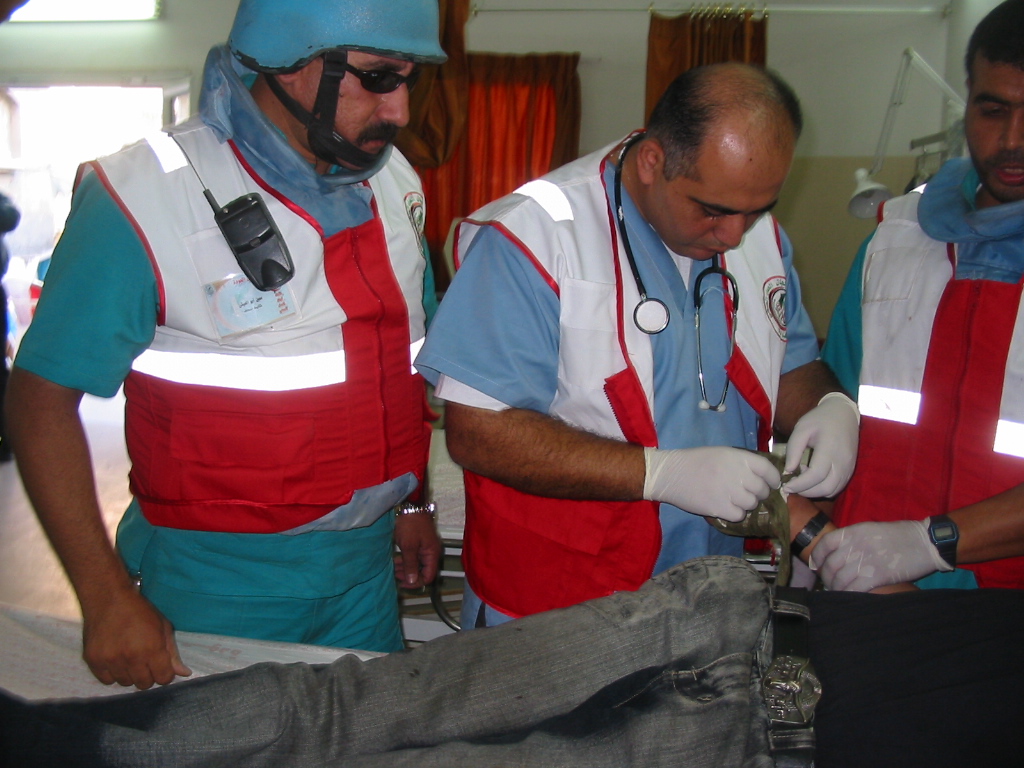
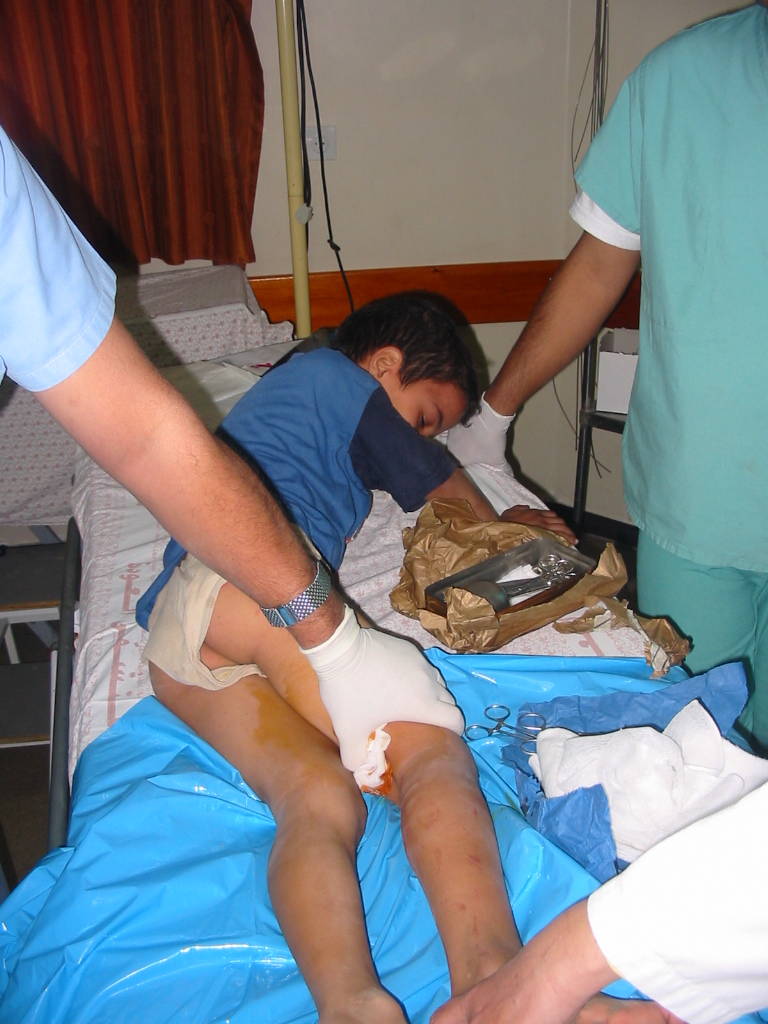
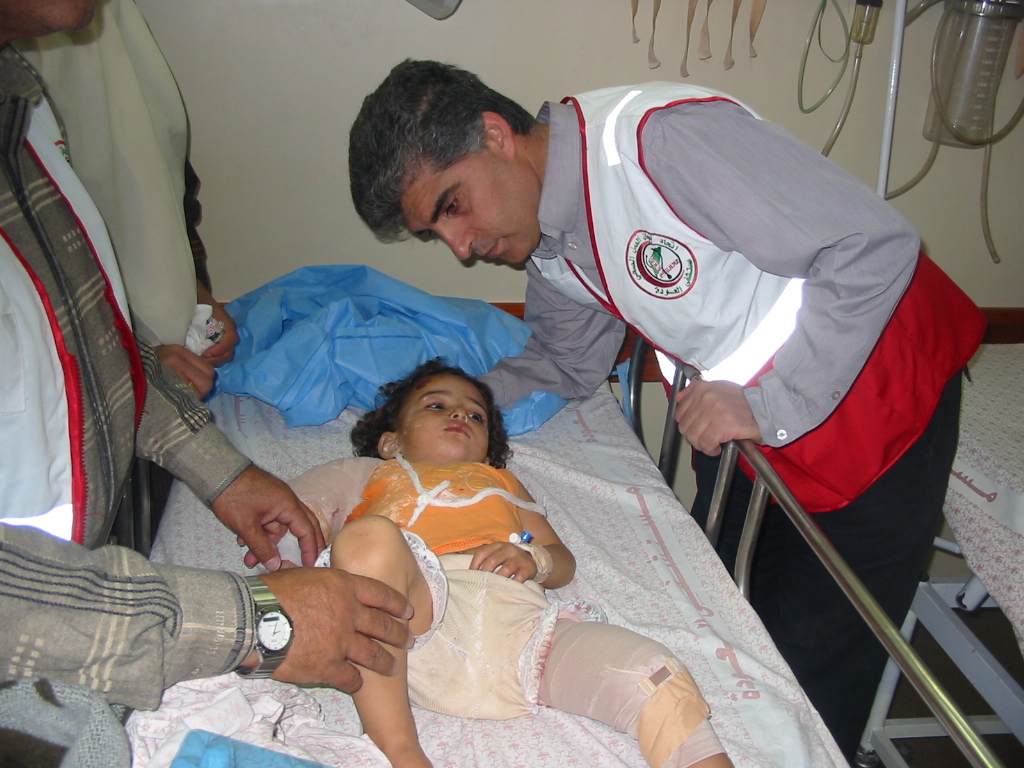
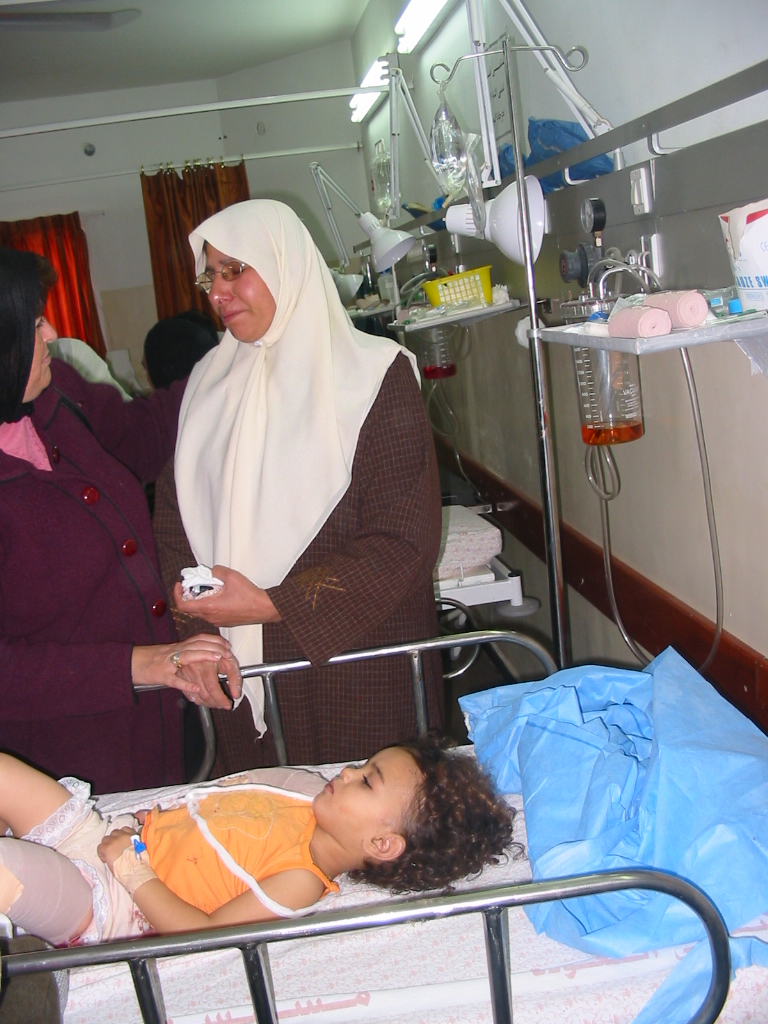
When I arrived the hospital, I decided that next time I would take the road through Jabalia Camp. But no one road is safer than another. My colleagues described a scene of small 3 to 5 year-old age kids who were transported to the hospital in their kindergarten bus. Their teacher, Samiha Khulif (age 26), was seriously injured while getting out of the bus by an Israeli missile launched at a target. I do not know what the target was but the teacher and nine other passersby were seriously injured and two teenagers were killed as they walked pas the bus on their way to school. The small children were all crying when they reached Al-Awda; they were terrified and trembling. The hospital staff tried to comfort them. It was an intense moment and some of my colleagues burst into tears after seeing these kids.

Inside the Hospital: Obs and Gyn. Department

Since the siege and the military operation has started in Beit Hanoun village, nine women from the village arrived at the hospital to give birth. They had to wait several hours at the checkpoint to get a permit to leave for the hospital for delivery. These women gave birth, but now cannot get back to their homes. Some stayed at the hospital, others were taken to stay with families that live in the same neighborhood as the hospital. I met one woman who gave birth by Cesarian Section. She was unable to talk. She had a beautiful baby and her mother was next to her in tears, worried about the rest of the family who are trapped in the village.

MECA offered help for the women. We gave out food, blankets, baby clothing and pampers which the hospital’s PR brought it from Jabalia.

USA Shrapnel
I have seen some of the shrapnel that was recovered from yesterday’s injuries and they are all clearly marked with “USA.” The shrapnel pieces seem unusual; our surgeons did not come across this before but we do not have the time and facilities to investigate. And any way of killing civilians is illegal, whether with knives or internationally banned weapons.

from Gaza with love
Dr. Mona ElFarra

Friday, November 03, 2006

injured dying while waiting apermit to the hospital in north of Gaza

Gaza: Beit Hanoun Siege Diary

Dr. Mona Elfarra

Wednesday 1 November 1.30 am
Khalil Hamad died waiting for a permit to go to the hospital!!!

Israeli occupying forces launched a massive attack against northern
Gaza, focused on Beit Hanoun village. At the start of this assault, the
village
was placed under strict siege. Nobody was allowed in or out of Beit Hanoun.

At AlAwda hospital where 45 injured were admitted for treatment, and 3
dead bodies received, I was told by our Emergency Room staff that one of
these dead could have been saved easily.

While bleeding and suffering from multiple injuries Mr. Khalil Hamad had
to wait for special
arrangements and an army permit to transfer him via the Red Cross
from outside the village to the nearest hospital (AlAwda) 5 minutes away from
the scene. Mr. Hamad bled to death before he arrived at our hospital.

A few
minutes means a lot in the ER room in such cases, not to mention that he
was left to die on purpose.

Speaking of war crimes and Geneva conventions, human rights violations
etc. etc., this frank violation of human
rights is the normal attitude and practice of the Israeli army in
Palestine.


Thursday 2 November

The ambulances were not allowed to enter the village, but they managed to
evacuate a few casualities on the outskirts while
working under heavy fire. Some cases arrived at the hospital where they
were operated upon, others were referred to the Gaza Central Hospital
Ashifa.

I was told by the surgeons that the injuries were all serious – to the
neck, abdomen, head, and lower extremities – and were caused by large-sized
bullets.


Friday 3 November 10 am

Women demonstrating and determined to break the siege
ER at AlAwda hospital

The 14 beds in ER were not sufficient to receive the injured.
A protest demonstration by the village women determined to
break the siege and free their men who were confined by the army inside one
of the village mosques. The women protested and managed to give free
passage to the men inside the mosque. At least 15 injured women
were received in the AlAwda Hospital, but 2 were shot dead by the Israeli
army.

This morning I visited some of the women inside the hospital. They were
still in
a state of shock, and deserve love, respect and quality medical care.

This is the Palestinian woman. She has always been an active part of
resisting the
occupation, and will continue to pay the price of striving towards freedom.

Death toll 25
Injured 115, many are women and children under 16

The operation is continuing and may extend to different areas. The streets
of Gaza are full of demonstrators.

in solidarity

Mona Elfarra

food aid distribution in Gaza

i received a question by (the road less travelled) asking for my comment regarding the food distribution in Gaza, here is my comment and iam sorry for the delay , i was highly distressed by the situation and focussed on practrical support for my community , and that drained alot of my time and efforts , beside the electricity inconvenience and lastly my email was not functioning for 10 days , proplem with the server , i do appologise again .

there are many aid orgs works in Gaza both local and international ,
the local and international are working with its high capacity ,via different organisations eg red crescent society , union of health work committees , pader , asalah org,islamic releif ,middle east council of churches dove and dolphin , middleast children allience(MECA), the Unrwa , World Food Programme and some more , those orgs have high level of coordination i mean the highest possible in Gaza under the current circamstances ,
there are big obstacles that faces those orgs ,the most important are the borders closure and lack of good storing circumstances on the borders, this affects both the food as well as medications ,and makes the food supplies irregular , specialy when we are talking about apopulation of 1.6million 70%of it depend on aid at the moment.
the civil society orgs are working continously to meet the population needs , and despite the seige and non stop military actions against palestinian people , social solidarity proved to be strong way of resisting occupation and sanctions , international solidarity is another way of resisting occupation.

in solidarity

while the world is silent

Gaza: While the world is silent
>
> Mona Elfarra
>
> This is happening in the north of Gaza, while the world is silent. Break
> the silence and speak for the speechless.
>
> Gaza 5pm Thursday 2 November 2006
>
> During its large scale military operation against Gaza, the Israeli
> occupying army today continued its attack on Beit Hanoun village in the
> north of the Gaza strip. Twelve people were killed and at least 75
> injured, many seriously. All casualities received at Al Awda hospital
> emergency room were seriously injured, with gunshot wounds to the chest,
> abdomen and head.
>
> Movement of ambulances in and outside the village is greatly restricted.
> Some patients needing renal dialysis cannot leave home for treatment, in
> fact many different types of patients are confined to their homes. The
> only hospital inside Beit Hanoun is surrounded by dozens of army tanks and
> military vehicles. With continous shelling and shooting, any moving body
> would be shot at once.
>
> All men over 16 wee asked to gather inside one of the village schools. As
> I write, the local radio station has just announced the death of one of
> the women trying to stop the army actions against her family.
>
> As medical teams we are working under great pressure. The situation has
> been very bad and now it is deteriorating daily, with sanctions against
> the Palestinian Authority, long periods of border closure, military
> assualts...
>
> We were hoping that negotiations for the release of the captured Israeli
> soldier would bring some hope for improvement of our situation, but it
> seems that Israel is pressing ahead with its preplaned agenda against Gaza
> and Palestinian people.
>
> I call upon you to spread the word and to try to shake the silent world.
>
>

Thursday, November 02, 2006

End the Assault Against North of Gaza

Press Release: 2 November 2006

END THE ASSAULT ON BEIT HANOUN

Yesterday the Israeli Occupation Forces began the
grotesquely named “Operation Autumn of Fury” on the
Gaza Strip. Beit Hanoun, scene of the continuing
massacre by Israel since June 25th, was re-occupied by
Israeli tanks. Since yesterday 12 civilians have been
shot dead and more than 65 woemn and children have
been injured. On the first dayof Eid Ul Fiter, last
week, 7 residents of the town were also killed by the
IOF.

The town of Beit Hanoun was bombed by Apache
helicopters and F16 and V58 fighter planes. All of
Beit Hanoun’s residents have no water or electricity
today. These air-strikes which damage essential
infrastructure and terrify the civilian population are
a form of collective punishment against the
Palestinian people and are war crimes which are
forbidden under international humanitarian law,
especially the Fourth Geneva Convention, which
prescribes the manner in which armies must treat
civilians during times of conflict.

We, therefore, call on the international community to
exert pressure on the Israeli Occupation Forces to
conduct itself within the boundaries of international
humanitarian law and ensure the protection of all
Palestinian civilians.

We also demand the immediate halt of the Israeli
Occupation Forces’ attacks on the Gaza Strip and an
end to the closure and isolation of the Strip, both of
which are exacerbating an already desperate
humanitarian situation inside the Strip.

For Comments contact:
Dr. Mona Al Farra +97082846602 or 0+972 599 410 741.
Dr Abu Ala'a, Gaza Strip, + 972 599 441766
Dr Asaad Abu Sharkh, Gaza Strip, + 972 599 322636
Dr Ayyoub Othman, + 972 599 412 826

Sunday, October 01, 2006

the right link for the bbc peace day in Gaza

http://news.bbc.co.uk/1/hi/talking_point/5356248.stm

Saturday, September 30, 2006

peace day Gaza

Peace Day: Gaza

I live in an area of conflict; so I am always thinking, working and hoping for peace. This hope for peace is a spontaneous, natural wish that lives inside me.

MEET THE BLOGGERS

Name: Monal El Farra
Lives: Gaza

I hadn't heard about this Peace Day before; and I don't think many other Palestinians knew of it either.

However, what we do know about is what it's like living under the Israeli occupation. Every day we suffer from this occupation which controls all aspects of our lives.

We are forced to live in a big jail called the Gaza Strip.

The occupation deprives us of the basic requirements of human life; we are not allowed to move freely inside our country; our children are starved; patients don't get the right treatment at the right time - many of them die.


We are all at risk of being caught in a military attack - anytime, anywhere.

Working for peace

There is an increasing number of Palestinian kids suffering from post traumatic stress syndrome.

There is an increase in the level of poverty; there is a lack of proper water; we live much of the day without electricity.

I dream of the day that I won't have to worry about the safety of my youngest daughter; whether she's at home, at school or coming back from school.

Many Palestinian kids have either lost their lives or have been injured while on their way to school.

The Israeli army has attacked civilians indiscriminately over the years. In the latest episode of hostilities in the Gaza Strip, starting on 27 June, 226 Palestinians have been killed.

I think more and more of peace. It is peace that we lack, and peace that we need to lead a normal life free of fear.

Hope

I think of a free country having different developed progressive institutions, for all its citizens, enjoying a normal life and being an important part of the prosperity of the world.

The Palestinian people have, for many decades, suffered a lack of peace and political stability.

We are displaced outside our original country, historical Palestine, which was under British mandate until 1948.

Peace without a just solution of the refugees' cause according to the UN resolutions, is an insufficient peace, and will collapse quickly.

Peace that is based on justice is a big goal for us in Palestine. It is for the benefit of all people in the area; a long-lasting comprehensive solution for the Palestinian-Israeli conflict.

Peace is inseparable from justice; only free people can enjoy peace.

Until that minute comes, I shall always work hard, and encourage others to work hard for a free, secular and democratic Palestine.

Mona ELFarra-Gaza-Palestine

Friday, September 29, 2006

Hello I'm back with love from Gaza

Dear all

Hello and sorry for not writing regularly,I didn't realize that it has been over a month since I wrote my last blog ,my son who is studying in Manchester , asked ,where Ian and what is the matter ? He knows very well that I usually write direct from my heart , and my heart is aching and full of pain agony anger and disbelief ,living through the continuous daily life under occupation , watching the young children , poor ,sick and miserable who currently need of the efforts of different aid organizations, to get their general basic needs food medicine ,school bags and uniform, ,with the increasing rate of violence amongst the Palestinian families and the anemia reached as high as 42%amongst gazan kids under 5 years ,no water no electricity . No proper food , as a result of the world economical sanctions and the daily military Israeli assaults, that are not covered by the media , everyday there is incursions , assassinations , home demolitions, and not to forget how 1.5 population are trapped inside Gaza ,
today 2 young brothers were killed while on while on their bikes , in the north of Gaza, everyday at least 3- 4 people are killed in different military actions .

I felt that I say the same things,I repeat on and on , this is the truth , I feel emotionally strained , but not defeated
,I'm like all of us here in Gaza , too much occupied by the unbearable
humanitarian crisis,I'm working all the time to secure medications , food,milk
, books for the community grants for the students ,in the most hard situation ,in the meantime following up
without real hope or enthiusam, the ongoing political marathon towards
the negotiations for Palestinian national unity government
,any way
,despite all what we are going through , we face our destiny With dignity ,
with resolve not ease,

here is the link for what I sent to the BBC on the international peace day ,on 21th of September
, with your support ,solidarity and courage to spread the truth , one day we shall all enjoy just fare peace.

in solidarity
Mona ElFarra


http://news/2/hi/talking_point/5356248.stm

It was up on the site for a good few days.

Monday, August 28, 2006

Gaza today after 2 months of the Israeli military operation

There are continous Israeli military operations against Gaza. In the east part of the city 8 people were killed and 17 injured, including journalists for Reuters. There is heavy shooting from the gunboats. Every day hospitals receive the killed and injured people. Our hospitals' use of diesel has increased since they must use electrical generators to run the operation rooms. I was told by the staff of the diagnostic center at the Palestinian Red Crescent Society for the Gaza Strip that the CT and mamogramm were not functioning properly due to the improper current supply. Those are highly sophisticated equipments and give very important diagnostic health services for patients in the whole Gaza Strip of 1.5 milion people.

Thousands of children suffer from post traumatic stress syndrome symptoms. They are going back to school next Saturday but there is no water, no electricity, no proper sewage system, no entertainment, no cash to buy food. The borders are closed; just opened rarely to let in some medications and humanitarian aid for the UNRWA. Public health has been greatly affected. An increasing number of families rely on aid to for food so many children do not have well balanced meals. Middle East Children's Alliance distributed 500 school bags and stationeries for kids of Gaza.

Life under occupation continues ....and the whole world's goverments are not only silent but amused watching Gaza and its population's humanitarian suffering. They are hurrying with impotent solutions while forgetting the origin of the proplem: OCCUPATION AND INJUSTICE

Mona

fishing in Gaza

I live by the seaside. I love the sea. When I was
young I always thought of myself as a fish that
cannot live outside its sea. I love swimming,
and walking by the sea any time, but specialy in the
morning and at sunset.
Now looking out of my window, watching the sea, and
the fishing boats, fills my heart with pain ,and
sadness, feeings I cannot describe. It is like a
monster's hand getting hold of my heart,strong
enough to crush it. I am resisting with my full
strength, but how long shall I stay strong
and resist? I do not know, I cannot predict.
All those thoughts crossed my mind while watching
some fishing boats which sailed too close to the
seashore. The gunboat's fires warned them to go back
to the harbour. But it is not just warning, it is
herding them, like a shepherd with its sheep,
ordering it to go back to the port .
Since the Israeli army's latest assaults against Gaza,
fishing boats are not allowed to go fishing. Few
take the risk of sailing too close to the seaside. But
all the time they are threatened by the warships'
direct shooting. Yesterday one of those boats was
under fire from the warships ,and was completely
destroyed and burned. Fishermen on board were not hurt
and they jumped into the sea.
I could not sleep, shooting continued all through
the night, so continuous and close to my
building that my daughter was frightened. We both
chose to sleep on the floor of my bedroom. I hardly
slept.
The fishing industry in Gaza has been paralysed for
the last 8 weeks. Since the capture of the Israeli
soldier, 3000 fishermen are not allowed to go fishing,
and 35.000 people who rely on this
industry are jobless. There is no fish in the Gaza
markets, though Gaza is famous for fish meals. This is
all over for the time being as anyway people do not
have the cash to buy a
non-existing nice fish meal. We can have fish and
other goodies only in our dreams.
Israel can never stop us dreaming .


Download this as a file

Tuesday, August 22, 2006

Solidarity message from Belgium

Just to send you my fellow feeling for you and all of you, Palestinians, suffering so much by the Israeli terrorism.

My father, from 18 to 20 years old, was a resistant during the second world war against the german nazis (a terrorist as the nazis said). Neither him, our family or the belgian civilians in general suffered so much as you do, and since so much years. (Except, yes, the Jewish).

How is it possible to live without anger in the day to day life, when your little brother, sister, your son or your daughter, your father or your mother is (or are) killed by militaries supported by all a people.

On vous aime, palestiniens. Oeuvrez pour la création de votre pays. Que ce soit votre seul et unique objectif dans les deux prochaines années.

Be safe

Saturday, August 19, 2006

Young voice from Jabalia refugee camp

Dear all
I would like today to introduce to you Adam Khalil ,you can learn more about him and about his life, under occupation in the Jabalia refugee camp in Gaza Strip from his blog directly http://nagyelali.blogspot.com

What concern me is to tell you how I got to know Adam. I started the Jabalia Library Project in 1992 as a response to Dr. Muneer Fascae, the ex-director of Tamer Institute in Ramallah. Dr. Fashae launched a campaign to encourage reading inside the Palestinian community and I responded by setting up the the library project next to the medical center in Jabalia where I work. The aim was to encourage youngsters to read and to provide them with the books. At that time, Adam came along with other kids pleased to be part of this activity inside the camp. This modest activity developed to be a nice kids club with different activities, where the kids can read, dance, play, paint, learn English, and other activities.

One of the goals of the project was to encourage kids to think in a democratic way and to give them a chance to read freely, different sorts of books. We didn't try to tell them what they should and shouldn't read, just provided them of a place of their own, distant from the poor crowded alleys of the camp and the violence and atrocities of the Israeli Occupation Army.

Another important goal of this center is to encourage kids to be active members in their community and to help in the development of their community by stregthening the humanitarian values of giving to others, and sharing with others.

There was an important idea in this work of how to invest human resources in the community; it is not the funds alone which were very scarce in the beginnings.


Over the years many kids benefited from this ongoing project. The project started as a dream, and the dream came true because every body was helping. We all helped and with the non stops efforts of the Union of Health Work Committees staff and members, as well as different outside groups and supporters for this work, and the people of Jabalia people, we all succeeded.

I felt proud and satisfied to come across Adam's Blog, to listen to this young voice from Jabalia telling the world what is going on in Palestine.


Yours in solidarity
Mona ElFarra


Ps I have been trying to post this for 3 days. The lack of power was a big proplem.

Wednesday, August 09, 2006

hello ... iam still there ..from Gaza with love

Dear all
responding to the request of Mr and Mrs. Angus Wright in France, i send this peice with love


I am a mother. I have 3 children, 2 girls and one boy. My son is Mohammed who is studying environmental sciences in the UK. My eldest daughter, Basma, is studying in Gaza, Alazhar University. She is married and living 700 meters away. My youngest daughter, Sondos, is 13. I am a physician by training and a community activist. I used to work with the Union of Health Work Committees, and now I’m the health development consultant for Al-Awda hospital (Jabalia refugee camp). I was one of the founders of this hospital in 1997, as well as community based programs that aim to improve health quality and link health services with cultural and recreation services, particularly in the most needy areas in Gaza.
I love Gaza, and would not replace it for any part of the world. It is my home and I have a cause to fight for here. We all struggle on different levels to achieve our national goals: freedom and an independent Palestinian state.

I was born and brought up in Khan Yunis town, southern Gaza Strip. I love the countryside, which has been largely destroyed over the years by the Israeli occupation. My late father’s citrus fruit grove was completely uprooted and destroyed, as well as our nice home, where my mother used to stay 6 months of the year. It was destroyed with many Palestinian farmers fertile agricultural land during the course of the Intifada. This land was a lifeline for many families, who had no alternative income.


Gaza became a big prison for its’ citizens, especially during the last 5 years. We have faced different episodes of violence, but this time is the worst, these atrocities have left one third of the population suffering from Post Traumatic Stress Syndrome (PTSS), as an outcome of going through traumatic experiences of home demolition, killing of family members, being at a site of shelling, assassination, and having the feeling of living in a big prison. The borders are closed most of the times which means we are not allowed in or out of our country, it has been closed completely for more than a month . And there is economic hardship, with high unemployment that reaches to 70%. Most people live under poverty levels in crowded towns, villages and refugee camps where the housing conditions are very limited and lack basic infrastructure.

When Israel launched its latest preplaned incursion into Gaza,under the pretense of the captured soldier release,on 28th of june ,the jet fighters destroyed Gaza’s main power plant. Since that date we don’t have regular electricity.we get 6- 8 hours of electricity each day, ; water is not available most of the time. We are subjected to artillery fire, gunboats and jet fighters shelling day and night. It is worse at night, and especially the sonic booming - when the airplanes break the sound barrier at high speeds and make great explosions. It makes me flinch in the daytime and jump out of my bed during the night. My heart rate goes fast and I hold on tight to my daughter. We need to pacify each other.

When it is dark children are afraid to stay on their own. Many children in Gaza suffer from nightmares and have become bedwetters.

Hospital services are severely affected. There are 22 hospitals in Gaza without electricity; they use alternative electrical generators. But these need fuel and we get fuel from Israel, and the borders are closed since the attack, so medical facilities are working under threat of lack of power and lack of medications. Many surgical operations had to be postponed; essentials drugs have been spoiled, due to lack of proper refrigeration.different sorts of medications are lacking in Gaza ,

Patients with chronic illnesses lack their regular medications. The bad health situation became worse due to the economic sanctions by the west since the election of our new government. Pre-mature babies on life support machines are under threat of death due to lack of reliable continuous power; so are many patients who needs regular renal dialysis.

Poverty and nutrition
Malnutrition amongst Palestinian children due to poverty and lack of proper balanced meals, affects 30% of the population. This will increase with the current lack of clean drinking water, and expected prevalence of diarrhea and other communicable diseases..

I live by the seaside, and since the start of the recent military operation against Gaza, I can see a deserted seaside. Families are afraid to take their children to the sea and children are afraid to go there as well after what happened with the Gallia family, when gunboats attacked a whole family, and killed most of its members by the seaside in the north of Gaza
. All the su or canceled, due to the emergency and dangerous circumstances. Families cannot afford the least expenses of transportation to the beach.
Children lacks recreation as well as safety.
160,000 employees have not received their salaries for 6 months when the economic sanctions were imposed on the Palestinians after the election election.

We live all the time in a state of fear of military assaults. I go to my work and kiss my daughter in the morning, not sure I shall see her in the afternoon. I am unable to plan any social event as simple as visiting friends or relatives.
While driving my car to work, and listening to the helicopters or drones in the sky, I cannot avoid thinking of danger, and telling myself, they might hit the car in front of me or the car behind me; I become restless, and panic until I reach my work. NO PLACE IS SAFE IN GAZA

During the incursion of north of Gaza
At Al-Awda Hospital in Jabalia camp I met with the medical staff who were exhausted after continuous emergency work during the incursion. Many injured arrived to the hospital and the staff worked round the clock. There were massive causalities. The 3 operating rooms were also working round the clock. The injured had serious injuries in the abdomen and chest. There were a good number of children in that attack who I visited while they were recovering in the hospital.

The staff’s main concerns were the electricity, fuel to run the generators, and vital medications for the operating room.
e small girls held my hand and said: look there, we were in the sun for a long period, next to the donkey place. It was hot, I was thirsty, my baby brother was crying, and I was terrified, I wet my pants.

I always think of the safety of the Israeli kids and civilians and I am totally against hurting civilians, but I do believe that the comparison of suffering is unfair, and not objective. I have an offer for Israel to send 1.5 million Israelis to live in Gaza, under these circumstances!!!!!!!
we both suffer, it is an outcome of injustice and occupation.

Saturday, August 05, 2006

Rafah 12.30 am 5th of August

The Israeli army continues its' military operation in Rafah in the south of Gaza. Army tanks are heading into the refugee camp under cover of helicopters that fire shells on the civilian population. Four citizens at least were killed, including one woman and two children, tens more are severely injured and reported to be received at Rafah's only hospital. The number will increase.

Many of the in-patients were discharged to make space for the injured. My colleagues tell me that the shelling is too severe and ambulances can't reach many of the injured. The army tanks are very close to the hospital and one of the houses in the area was specifically targeted.

It seems that the military operation into Rafah will continue.......as evidenced by the increasing number of army tanks in the area.

Friday, August 04, 2006

french version of my blog

Dear All
just to let you know that a freind from Canada, offered to translate some of my posts to french, i think it is excellent idea ,great effort too, the english posts will continue...iam afraid i donot know french ,i only know jeutame , monamoure,iam sorry i donot know french
in love and solidarity
Mona

Thursday, August 03, 2006

The Morality of The Israeli Army

Gaza Strip 1st of August 2006

Today the Israeli Occupying Forces redeployed into the area south east of Rafah, targetting Alshoukas village. They launched a big military operation against the village in a desperate attempt to demolish alleged tunnels. At least 50 army tanks along with helicopters and drones took part in this operation. What concerned me is that 8 people were killed, amongst them 2 Palestinian fighters, and the rest were civilians including one boy age 11. 26 people were injured, ten are in serious conditions.

The health emergency teams were not allowed entry to rescue the injured for 12 hours, leaving the injured to face their destinies. I am sure, as are my colleagues at the Rafah hospital, that this inhuman act increased the number of the dead and seriously injured. During the operation, ambulances were also attacked by shelling at the hospital's gate. Tens of families in the village were forced to leave their homes; children, women and men left their homes because the shelling was too severe/

What of morality? Of the Fourth Geneva convention and its charters regarding civilians and the safety of health teams working during war times? This accord means nothing and is not respected by the Israeli army. For us here in Palestine, we know very well that Israel, with its colonial-Zionist ideology, aims to kill more and more Palestinian civilians. During its so called military operations to "defend its security", hundreds of civilians including entire families were unnecessarily killed.

Israel aims to break the Palestinian people's will and determination to achieve their inalienable nationals goals. I said before they will not succeed and I am saying it again and again. It is impossible to control an entire nation using collective punishment and continuous occupation. It is impossible to confiscate am entire nation's right of freedom and self-determination. Israel and the United States should read history lessons.

Here in Gaza City the artillery shelling continued in the east and north. We don’t have air raids shelters, we don't have electricity, we don’t have clean water. The war boats patrol the sea and the helicopters continue their shelling at all times of the day. Lately, Israel has also been distributiing of flyers against resistance movement.

I was in the Omar Elmukhtar high street and watched the sarcastic expression on the faces of a bunch of teenagers as they picked up these flyers and read them. I remembered myself as a teenager during 1967 war time. I read the same sort of flyers and laughed. Israel aims to make Palestinian people hungry, thirsty, to make us face humanitarian disaster after humanitarian disaster, and dependent on the world's sympathy.

We are a nation with a noble cause; we resist injustice and occupation. We are not alone and we know that very well. What we face is the most ugly version of the United States' imbalanced policies in the Middle East. The immorality and injustice of these policies will reflect itself on the future of USA, let us wait and see.

P.S. I was asked by some of you why I keep referring to the Israeli army as occupying army. This is the truth AND I AM SAYING THE TRUTH. The disengagement plan from Gaza last Septemper did not end the occupation of Gaza and the West Bank. All it has meant for me is that I can visit my mother in the south (20 km drive) without passing through the Israeli checkpoints. But I am still under the threat of the jetfighters, sonic booms, and continuous shelling from the north and east. Israel still has control of the commercial borders and has closed them at will causing shortages of baby formula, bread, food, and medicine. Israel and the rest of the world have imposed economic sanctions on us as a collective punishment for our choice during the January election. How would you define the above but occupation?

In love and solidarity
Mona

Sunday, July 30, 2006

CRI DE LIBERTÉ

16 juillet

1h30
Une forte explosion me réveille, ma fille de 13 ans est terrifiée et se cache la tête sous les couvertures. J’allume la petite radio transistor, et j’apprend que les avions F16 ont frappé l’édifice des Affaires extérieures avec un missile, c’est la deuxième fois en une semaine. J’ai immédiatement pensé à Fawaz et Nawaf, mes amis d’enfance et leurs familles, je n’ai pas eu le courage d’essayer de les contacter. Le son de l’explosion était trop fort, il a fait trembler mon appartement qui est pourtant à plus de 500 mètres de là…

7h30
Après avoir essayé en vain de dormir, je décide de me lever, et je me précipite vers la maison de mes amis. Ils n’étaient pas blessés mais la scène était choquante. Fawaz était effrayé, incapable de se concentrer, son frère et les enfants étaient traumatisés, il m’a montré le jardin, où de vieux arbres ont été complètement détruits. Les vitres de leur édifice et le jardin étaient couverts par les ruines et les débris du ministère des affaires extérieures. Pourquoi diable frapper le même bâtiment deux fois dans la même semaine, il ont fait la même chose avec le bâtiment du ministère de l’intérieur, près de chez mon amie Hoda.

C’est une punition collective massive, systématique, planifiée et terrifiante.

Pas d’électricité, pas d’eau, pas de lait pour les enfants, pas de sécurité, des frontières fermées, à l’intérieur desquelles 1.5 millions de personnes sont enfermées dans leur propre pays. 4 semaines de bombardement continu, en provenance de la mer, de la terre et des airs, qui ciblent les populations civiles : 110 personnes ont été tuées en 3 semaines (dont 45 étaient des enfants), des centaines ont été blessées. Le soldat kidnappé n’était qu’un prétexte pour une attaque systématique et planifiée d’avance, et cette punition collective n’est qu’une tentative désespérée par les IDF (Israel Defence Forces, l’armée israélienne) de détruire notre volonté et notre détermination d’atteindre nos buts nationaux, mais ils ne réussiront pas, ils ne réussiront pas, et devraient tirer des leçons de l’histoire.
Nous somme parfois fatigués, et il nous arrive de nous plaindre, mais heureusement les Palestiniens et les Palestiniennes n’ont pas la mentalité des victimes, ils ont la mentalité des combattants pour la liberté (freedom fighters), et avec l’aide d’autres gens qui se battent chaque jour contre l’injustice, avec votre solidarité, nous allons vaincre.

19 juillet

16h00
Camp de réfugiés de Almagazi, à l’est de Gaza
C’est la deuxième journée de l’incursion de l’armée israélienne dans le camp Almagazi, dans le milieu de la bande de Gaza. Il y a des bombardements qui viennent de la mer, de la terre et des airs, 9 personnes ont été tuées, au moins 45 civils ont été blessés dans les premières heures de l’incursion. Pas d’eau, pas d’électricité, les hôpitaux peinent à prendre soin des blessés dont le nombre augmente, l’urgence fonctionne uniquement avec une génératrice.
Village de Beit Hnoun, au nord de Gaza
L’armée est sortie du village, après avoir démoli 40 maisons, tué 12 personnes et blessé des dizaines d’autres, en plus d’avoir détruit d’importants espaces de terres agricoles, blessé 2 journalistes et 2 membres d’équipe de secouristes. Notre équipe à l’hôpital Al Awda était débordé par le nombre des blessés. L’armée est restée 3 jours dans le village, et a laissé derrière elle une grande destruction. L’équipe de l’ONU-OSO a indiqué que plusieurs familles ont grand besoin de nourriture pour bébés, qui n’est pas fourni par l’ONU, je vais m’assurer de distribuer ce lait à travers MECA (Middle East Children Alliance) dès demain.

Alors que j’écris, on peut entendre de grosses explosions successives en provenance des bateaux militaires et des hélicoptères Appache, en plus du son des drones. Sans électricité, ce n’est pas évident d’écrire, à la lumière d’une chandelle ou de la lampe à kérosène.

En toute solidarité,
Mona ElFarra

17 juillet

17 juillet
À perte de vue, que des ordures
La pénurie d’essence a obligé les camions à ordure d’arrêter temporairement la collecte, il y a donc des ordures qui encombrent les rues de chaque ville à Gaza, et qui posent une menace sérieuse pour la santé et l’hygiène. Hier seulement, je regardais à ma fenêtre et j’ai vu des enfants fouiller dans une pile d’ordures. Demain j’ai convoqué des représentant-es d’organisations palestiniennes pour mettre en place un système de collecte des ordures bénévoles pour alléger le problème.

Visite au Ministère des affaires extérieures
Hier dans la nuit je me suis réveillée à 1h15 du matin. Il y a eu un gros boum!, puis le son d’un avion qui passait au-dessus de nos têtes. Quand j’ai allumé ma radio à piles, j’ai appris qu’un avion F16 a bombardé le ministère des Affaires extérieures pour une deuxième fois.
Ce matin je suis allée voir les dommages et visiter mes amis qui habitent dans l’immeuble voisin du ministère. Ils n’ont pas été blessés mais tout leur quartier est plein de décombres. Ils venaient à peine de finir de nettoyer les dommages du dernier bombardement, 5 jours plus tôt.

la version française du Boston Globe Article

Depuis l’enlèvement de Gilad Shalit, le soldat israélien, la Bande de Gaza a été soumise à une opération militaire de grande envergure, connue en Israël sous le nom de « Pluie d’été » (Summer Rain). Puisque Israël a bombardé notre unique centrale électrique, et puisqu’il faut de l’électricité pour pomper l’eau, la majeure partie de Gaza n’a plus accès à l’eau potable. Dans la chaleur de notre été, de la vraie pluie serait pour nous un cadeau du ciel.

Pour le monde extérieur, la décision peut sembler facile pour les Palestiniens : laissez partir le soldat et le siège va se terminer. Pourtant, pour nous les habitants de Gaza, même confrontés à cette violence extrême, une autre décision s’impose – pas avec facilité, mais avec détermination. Shalit est un soldat, qui a été capturé dans le cadre d’une opération militaire. Aujourd’hui, 122 femmes et 400 enfants palestiniens sont détenus dans les prisons israéliennes. Ils ont droit à leur liberté tout autant que Shalit. Leurs familles ressentent la douleur de leur absence, tout autant que la famille de Shalit. Ainsi, alors que nous subissons la « Pluie d’été » d’Israël, la plupart des gens de Gaza veulent que le soldat reste détenu – pas blessé, seulement détenu – jusqu’à ce que nos femmes et nos enfants soient libérés.

Nous allons payer le prix fort, et ce pendant longtemps après que les bombes se soient tues. Je commence déjà à perdre la notion des jours et des nuits, à compter les bombes qui sont tombées. Depuis que la centrale électrique a été détruite, nous devons vivre sans électricité. Celle que nous réussissons à obtenir est aléatoire, une heure ou deux au plus, juste assez pour recharger nos ordinateurs portatifs et nos cellulaires qui nous permettent de ne pas perdre complètement le contact entre nous et avec le monde extérieur.

En tant que médecin, j’ai peur pour les hôpitaux, pour nos patients. Vingt-deux hôpitaux n’ont plus aucune électricité. Ils doivent fonctionner uniquement avec des génératrices – mais les génératrices fonctionnent avec du combustible, et nos réserves de combustible sont dangereusement basses. Nous en avons assez seulement pour quelques jours de plus. Mais nos frontières sont fermées hermétiquement, et aucun combustible ne peut entrer dans notre territoire. Des centaines de chirurgies ont été reportées. Les vies des patients qui dépendent de machines, des enfants aux soins intensifs, des patients en dialyse rénale et de bien d’autres sont menacées par le manque d’électricité. Nos pharmacies étaient déjà presque vides à cause de la fermeture des frontières et des sanctions économiques qu’on nous a infligées. Le peu qu’il restait a été perdu parce que les médicaments devaient rester réfrigérés.

Plus de 30 000 enfants souffrent de malnutrition aujourd’hui, et ce nombre ne va qu’augmenter alors que la diarrhée se répand à cause de la pénurie d’eau potable et des hauts taux de contamination de la nourriture.

En tant que mère, j’ai peur pour nos enfants. Je peux déjà voir les effets du bruit continu des bombes soniques et des bombardements d’artillerie sur ma fille. Elle a 13 ans et elle est agitée, paniquée. Elle a peur de sortir, mais est frustrée de ne pas pouvoir voir ses ami-es. Lorsque les avions israéliens brisent le mur du son, ce qu’ils dont à toute heure du jour et de la nuit, le son qu’ils produisent est terrifiant. Mon lit tremble énormément. Ma fille saute au lit avec moi, frissonnante de peur. Puis, nous finissons toutes les deux blotties sur le plancher. Mon cœur bat à tout rompre, mais je dois pourtant rassurer ma fille, pour qu’elle se sente en sécurité. Elle a désormais compris que nous devons nous rassurer l’une l’autre. Elle sent ma peur. Lorsque les bombes explosent, je tressaille et je hurle. Je ne peux pas m’en empêcher. Je suis une docteure, un femme d’un certain âge, mature. Mais lors des bombardements soniques, je deviens hystérique. Je ne suis après tout qu’un être humain, et nous avons tous un seuil au-delà duquel la peur et la douleur prennent le dessus.

Cette agression va laisser des cicatrices sur la psychologie de nos enfants pour plusieurs années à venir. Le fait d’instiller la peur, la colère et le deuil dans nos enfants ne va amener ni la paix, ni la sécurité pour Israël.

Plusieurs d’entre nous ici à Gaza pensons que l’opération « Pluie d’été » était planifiée d’avance par Israël, que le kidnapping de Shalit a été utilisé comme prétexte. Israël a attaqué Gaza à peine quelques heures avant la signature d’un accord de consensus national signé par le Fatah et le Hammas, un accord qui aurait pu mener à des négociations entre Palestiniens et Israéliens. Pourtant Israël sait bien que pour que des négociations fonctionnent ils devraient abandonner son désir de garder le contrôle de la terre et des ressources palestiniennes. Nous, à Gaza, pensons que le but de la campagne militaire d’Israël contre nous n’est pas la libération de Shalit. Leur but est de faire tomber notre gouvernement démocratiquement élu et de détruire notre infrastructure, et avec elle notre volonté d’obtenir nos droits nationaux, nos droits sur les petits morceaux de territoire qui nous reste. Même si ne vivons pas avec facilité, nous vivons avec détermination. Jusqu’à ce que le monde force Israël à reconnaître nos droits sur notre territoire et à chercher une paix qui donne à la fois la liberté et la sécurité aux deux peuples, nous allons tous continuer à payer le prix.

version française du blog "From Gaza, with Love"

Thank you to Anais from Canada for generously translating my writing!

Je suis une médecin de profession, mais m'a pratique a fait de moi une militante pour les droits humains et les droits des femmes. J'habite dans la Bande de Gaza, en territoire occupé.


Note de la traduction
Vous consultez présentement la version française du blog « From Gaza, with Love », de la Dr Mona El Farra.. La traduction est bénévole et non-professionnelle, et a commencé au mois de juillet. Tout le blog n’est pas disponible en français, nous tenterons plutôt de le mettre à jour et de faire du rattrapage si c’est possible. La traduction est faite à partir du Québec, ce qui sera peut-être reflété dans certains choix de vocabulaire.

27 mars
Bonjour à vous tous,
J’ai toujours voulu avoir un blog, dans lequel je peux écrire, ventiler et parler au monde entier de ce qui se passe en Palestine, un blog qui serait ma fenêtre sur le monde, dans une grande prison comme Gaza. Nous devons continuer à vivre, ou du moins à essayer de vivre, pendant que tout le monde nous demande « Mais comment faites-vous pour vivre à Gaza sous l’occupation? », oui nous pouvons, oui nous l’avons fait, et pour encore plusieurs années nous allons continuer à lutter et à résister à l’occupation, jusqu’à ce que la justice prévale. Un jour notre pays sera vraiment libre, et tous nos efforts seront concentrés pour améliorer la qualité de vie pour les Palestiniens qui souffrent depuis de décennies, mais qui jamais n’ont eu l’attitude de victimes, qui jamais n’ont attendu pour la charité du monde. Nous avons toujours été des combattants pour la liberté (freedom fighters) et nous allons continuer notre lutte vers la liberté. Durant mon court séjour en Grande-Bretagne, où j’étais invité par un groupe de femme de Sheffield à l’occasion de la journée internationale des femmes du 4 au 15 mars, j’ai promis à mes camarades et sœurs de Sheffield que je commencerais ce blog dès mon retour, c’est donc ce que je fais avec l’aide de ma nièce Leila, et les encouragements de mon fils Mohammed, qui m’a toujours donné beaucoup de support pour mon travail et mes différentes activités, ma fille Basma est aussi très patiente avec moi quand j’utilise l’ordinateur, et corrige mes textes.
Je vais donc vous tenir au courant, je suis très occupée avec la campagne sur le lait, qui requiert beaucoup de travail. Nous avons plusieurs bénévoles pour distribuer le lait et s’assurer qu’il arrive jusqu’au familles les plus pauvresé
Avec amour, en toute solidarité.
Mona ElFarra

Saturday, July 29, 2006

Bad news I'm sorry

THE MOTHER I MENTIONED IN MY PREVIOUS STORY COULDN'T MAKE IT. SHE PASSED AWAY 3 HOURS LATER LEAVING BEHIND HER HUSBAND SAMIR AND THEIR 2 CHILDREN. ONE OF THE GIRLS WAS SERIOUSLY INJURED AND IS STILL AT THE HOSPITAL.
SOMIA, THE MOTHER, WAS HANGING UP THE CHILDREN'S CLOTHES AT HER HOME IN JABALIA WHEN SHE AND HER CHILDREN WERE HIT BY THE MISSILE. SOME NEIBOUGHERS TOLD ME THAT THE BABY WAS NEXT TO THE MOM, INSIDE HER PUSHCHAIR.
I'M UNABLE TO VISIT THE FAMILY.
I HAVE NO WORDS.

WITH LOVE AND SOLIDARITY
MONA

Wednesday, July 26, 2006

home sweet home ...I wonder

All that is happening right now in Gaza


Wednesday
26th of July
6:45 pm
Al Awda Hospital Emergency Room
Jabalia refugee camp

Shahd, an 8 month baby girl, and Maria, a 4 year old child, arrived at the hospital dead.

Somia and her remaining two daughters arrived at the hospital suffering from serious injuries. The 2 girls are now in the operating room where doctors are trying hard to save their lives. The mother’s injuries are very critical; she was referred to Gaza City's central hospital, Al Shifa, for treatment.

Samir, an extremely traumatized husband and father, was unable to believe what happened to his family.

Early this evening an Israeli army tank launched one missile at this family’s home inside Jablia refugee camp. The Israelis are conducting a large-scale raid against the camp and the eastern part of Gaza City.

This assault started in the early hours of this morning. At 4 am loud explosions from the sea, air and land woke me and all the of Gaza City and Jabalia's citizens. I did not know what was happening until I switched on my little battery powered radio. The death toll reached 24, a number that might increase. Tens of injured are being sent to all of the town’s different hospitals including Al-Awda in Jabalia.

Many homes were demolished, many places are hazardous to reach. The roads are deserted and the general mood is anxiety and insecurity. Many children lost their parents, many parents lost their children. Our news isn’t covered; people are feeling disappointed, devastated and abandoned by the world’s reaction, especially the governments.

Your solidarity is highly needed at these times. Please spread the truth - the Israeli occupying force is using excessive force in Gaza and Lebanon.

End occupation! End the aggression against Palestinians and Lebanese!

Yours in love and solidarity,
Mona

Sunday, July 23, 2006

some photos to share


Top photo: my daughter, sondos, with her friends who live next to the Palestinian Ministry of Foreign Affairs. The children were sad to see the trees destroyed by the big blast.

Bottom photo: Some of the girls inside New Horizon Center in Nuseirat refugee camp


During my visit to a children's center in Nusseirat refugee camp, the sound of artillery shells being fired at the nearby AlMagazi refugee camp was loud. The girls inside the center took me around to see their arts and crafts activities. The most moving one was the dream tree in which girls age 11-14 expressed their dreams of safety, education, sports activities, reading good books, traveling, going to the seaside, visiting friends relatives, having electricity and good drinking water, etc...

One of the girls said, "We will never give up dreaming. I dream of living in Yafa where my family lived before 1948. My grandmother tells me how life was great in Yaffa and I dream of going back. Nobody can stop me from dreaming, nobody should take my dreams away."

The girls danced to the music of Palestinian folklore and I passed message of love and solidarity from friends allover the world who believe that Palestinian people have the right to live in dignity, by achieving their national goals of freedom and self-determination. Meanwhile, the Israeli's artillery shelling continued.

As I started my journey back to Gaza city, a drone was in the sky and gunboats were
patrolling the sea. Driving on the rough side road, I passed by the destroyed bridges and paralyzed power plant and I thought of the drawings I saw in the center of army tanks, dead, injured, funerals, masked men.

I dream of the day when I shall be able to see children's drawings of green spacious parks, meadows, sports activities and safe seaside.

Saturday, July 22, 2006

Wednesday, July 12, 2006
'Never again' gone mad in Israel
By SANDY TOLAN
GUEST COLUMNIST
In the name of forcing the release of a single soldier, Israel has seized members of democratically elected government; bombed its interior ministry, the prime minister's offices and a school; threatened another sovereign state (Syria) with a menacing overflight; dropped leaflets from the air, warning of harm to the civilian population if it does not "follow all orders" of the Israel Defense Forces; loosed nocturnal "sound bombs" under orders from the Israeli prime minister to "make sure no one sleeps at night in Gaza"; fired missiles into residential areas, killing children; and demolished a power station that was the sole generator of electricity and running water for hundreds of thousands of Gazans.

Besieged Palestinian families, trapped in a locked-down Gaza, are down to one meal a day, eaten in candlelight. Yet their desperate conditions go largely ignored by a world accustomed to extreme Israeli measures in the name of security.

"Wake up!" shouted the young Palestinian journalist Mohammed Omer from Gaza on San Francisco's "Arab Talk" radio in late June. "The Gaza people are starving. There is a real humanitarian crisis. Our children are born to live. Don't these people have any heart? No feelings at all? The world is silent!"

For the Palestinians, Omer's cry speaks to a collective understanding: That the world sees the life of an Arab as infinitely less valuable than an Israeli's; that no amount of suffering by innocent Palestinians is too much to justify the return of a single Jewish soldier. This understanding, and the rage and humiliation it fuels, has been driven home endlessly through decades of shellings, wars and uprisings past.
Indeed Omer's plaintive words form a mantra, echoing all the way back to the first war between the Arabs and the Jews.

The Arab-Israeli war of 1948, known in Israel as the War of Independence, is called al-Nakba, or the Catastrophe, by Palestinians. During the 1948 conflict, more than 700,000 Palestinians fled the violence or were driven from their homes. In the middle of July, when temperatures exceeded 100 degrees, more than 30,000 Arabs marched into exile, some for more than 20 miles. Many never made it; those who did were certain they would be coming back in a matter of days or weeks. Fifty-eight years later, they remain in exile.

Some refugees wear the keys to their homes around their neck; others tell stories of golden fields, or of a lemon tree whose fruit grows larger in the memory with each passing year.

Fifty-eight summers after the Nabka, as U.S.-made weapons pound Gaza from Israel, a déjà vu settles on the old men and women of the refugee camps, and in the vast diaspora beyond, reminding them of yet another bitter anniversary.
The latest attacks by Israel in Gaza, ostensibly on behalf of a single soldier, recall the comments by extremist Rabbi Yaacov Perrin, in his eulogy for U.S. Jewish settler Baruch Goldstein, who in 1994 massacred 27 Palestinians praying in the Hebron mosque. "One million Arabs," Perrin declared, "are not worth a Jewish fingernail."

Israelis, too, are a traumatized people, and their nation's current actions are driven in part by a hard determination, born of the Holocaust, to "never again go like sheep to the slaughter." But if "never again" drives the politics of reprisal, few seem to notice that the reprisals themselves are obscenely out of scale to the provocation: For every crude Qassam rocket falling harmlessly, far from its target, dozens, sometimes hundreds of shells rain down on the Palestinians. For one missing soldier, a million and a half Gazans are made to suffer. In Israel, today, it is "never again" gone mad.

The irony is that, contrary to making themselves more safe, the Israelis, just like the Americans in Iraq, are only sowing the seeds of more hatred and rage.

Sandy Tolan is author of "The Lemon Tree: An Arab, A Jew, and the Heart of the Middle East" and a professor at the Graduate School of Journalism at the University of California-Berkeley.